
Introduction
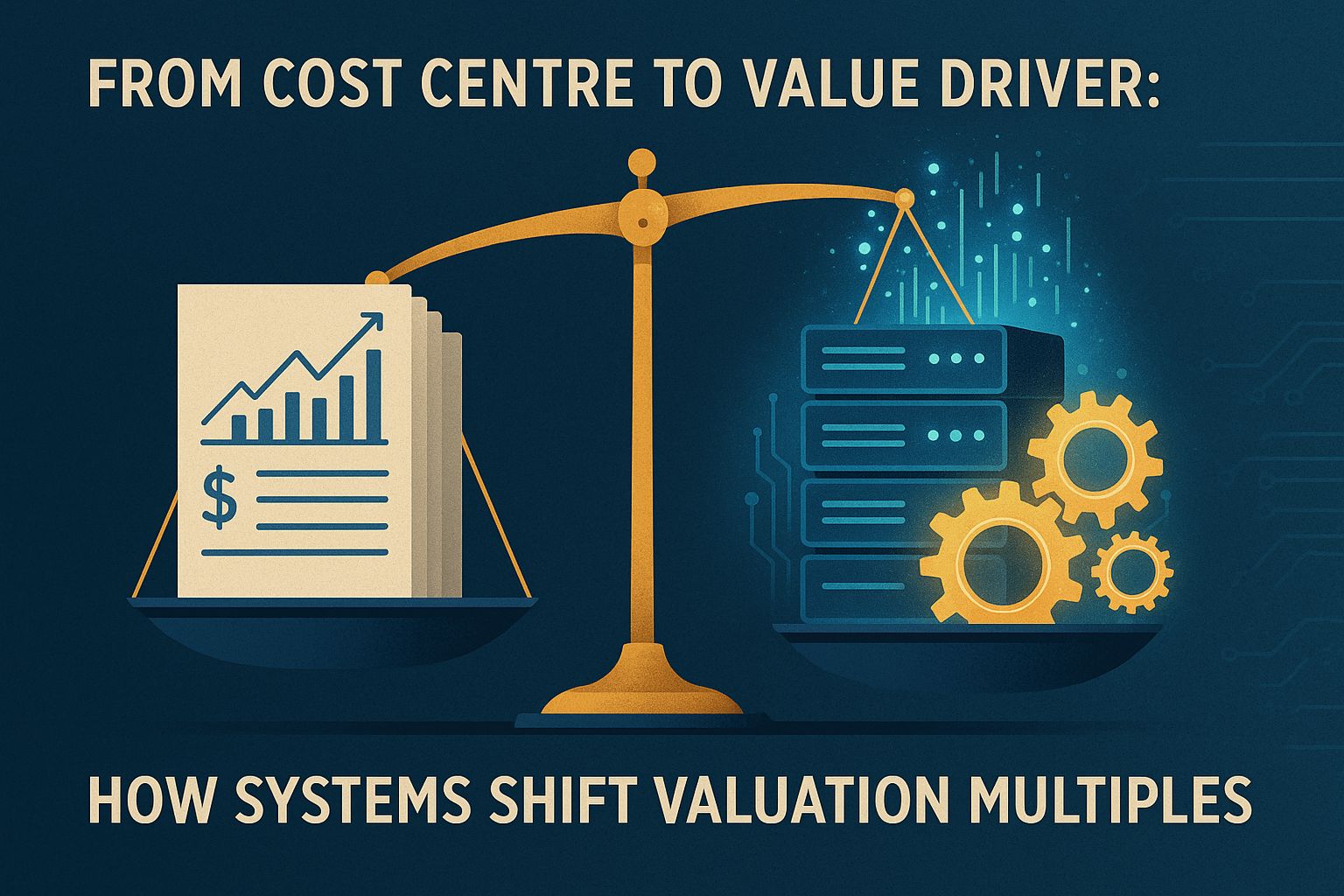
For decades, systems were considered little more than a “cost of doing business.” Finance, HR, IT, and operations systems were managed in the background — necessary, but rarely viewed as a strategic lever. Today, that view has flipped. Modern investors and acquirers are scrutinising systems not just as operational enablers but as direct drivers of valuation multiples.
When systems drive scalability, resilience, and differentiation, they push businesses into higher-value categories. Conversely, outdated, fragmented, or risky systems can suppress valuations — even in companies with strong revenue growth.
This article explores how systems have shifted from cost centre to value driver, why investors care, and what real-world examples teach us about the link between systems and enterprise value.
Why Systems Now Influence Valuation Multiples
The Investor Lens Has Changed
In the 1990s and early 2000s, investors placed primary emphasis on top-line growth and EBITDA. Systems were buried in SG&A and rarely received due diligence scrutiny. Fast forward to 2025, and investors are operating in a world shaped by:
Cloud scalability – Businesses can scale globally without proportional cost increases.
Cyber risk – Weak systems can create catastrophic value destruction overnight.
AI and automation – Intelligent systems unlock productivity and growth multiples.
Integration – Seamlessly connected systems reduce friction, accelerate M&A synergies, and enable rapid pivoting to new business models.
- Systems are no longer invisible plumbing — they are the infrastructure of enterprise value.
Multiples Reflect More Than Revenue
Revenue remains critical, but it is not the only story. Two firms with identical $100m revenue streams can attract dramatically different valuations depending on system maturity.
Company A with manual workflows, outdated ERP, and weak data security might trade at 6–7x EBITDA.
Company B with modern, integrated systems enabling global scalability might command 9–11x EBITDA.
Investors price not just what the company earns today, but how resilient and scalable it is tomorrow.
Real-World Case Examples
Netflix: Data Systems as a Growth Engine
Netflix built its valuation moat on a data-driven recommendation system that personalises user experience for 260+ million subscribers. This system directly impacts revenue retention, upsell, and international scalability. Analysts consistently link Netflix’s valuation premium to its proprietary data systems, which competitors struggle to replicate.
Atlassian: Scaling Without a Sales Force
Australian-born Atlassian disrupted the enterprise software market with a unique system-driven model: automated, self-serve digital distribution of its tools (Jira, Confluence, Trello). Instead of a large sales force, Atlassian’s systems enable efficient customer acquisition and expansion. Investors reward this with premium valuation multiples relative to peers.
Target: The Cost of System Failure
On the flip side, Target’s infamous 2013 data breach (impacting 110 million customers) wiped billions off its market cap in days. The company’s recovery required years of investment in cybersecurity. Investors view such failures not as operational hiccups but as direct valuation risk.
Tesla: Integrating Systems Into Manufacturing
Tesla’s valuation premium over traditional automakers stems not only from EV growth, but also from its vertically integrated systems. From battery management to over-the-air software updates, Tesla’s system integration accelerates innovation cycles and creates defensible differentiation.
The Valuation Playbook: How Investors Assess Systems
Scalability
Can the business double revenue without doubling headcount? Cloud-native, automated, and API-driven systems allow efficient scaling, which investors price at a premium.
Resilience
Cybersecurity, compliance, and disaster recovery capabilities are now non-negotiables. Weakness here can reduce multiples significantly.
Differentiation
Does the company use systems to create unique customer experiences (e.g., Netflix) or operating models (e.g., Atlassian)? Proprietary system advantages increase strategic value.
Integration Potential
In M&A, the ease of system integration directly affects synergy realisation. Investors discount valuations if system integration looks costly or complex.
From Plumbing to Premium: The CFO’s Role
For CFOs, the shift is profound. Systems strategy is no longer a CIO-only concern. When preparing for valuation events (capital raising, private equity, IPO, or trade sale), CFOs must:
Assess system maturity against investor expectations.
Quantify productivity and scalability gains delivered by systems.
Demonstrate resilience via strong cybersecurity frameworks.
Highlight differentiation enabled by system design.
The CFO narrative is no longer just about numbers — it’s about how systems underpin future growth and risk mitigation.
Practical Steps to Reframe Systems as Value Drivers
Audit current systems: Benchmark against investor-grade maturity models.
Prioritise integration: Reduce silos; ensure core systems “talk” to each other.
Invest in cybersecurity: Treat it as a valuation defence strategy, not IT spend.
Leverage analytics & AI: Position systems as engines of insight and growth.
Tell the story: Build investor decks that link system investments directly to scalability, resilience, and competitive advantage.
Conclusion
Systems have moved out of the back office and into the valuation spotlight. What was once an overlooked cost centre is now a direct lever of enterprise value. Investors reward companies that demonstrate scalable, resilient, and differentiated systems with higher multiples.
In 2025 and beyond, the businesses that treat systems as strategic value drivers will command the strongest investor confidence — and the highest valuations.
